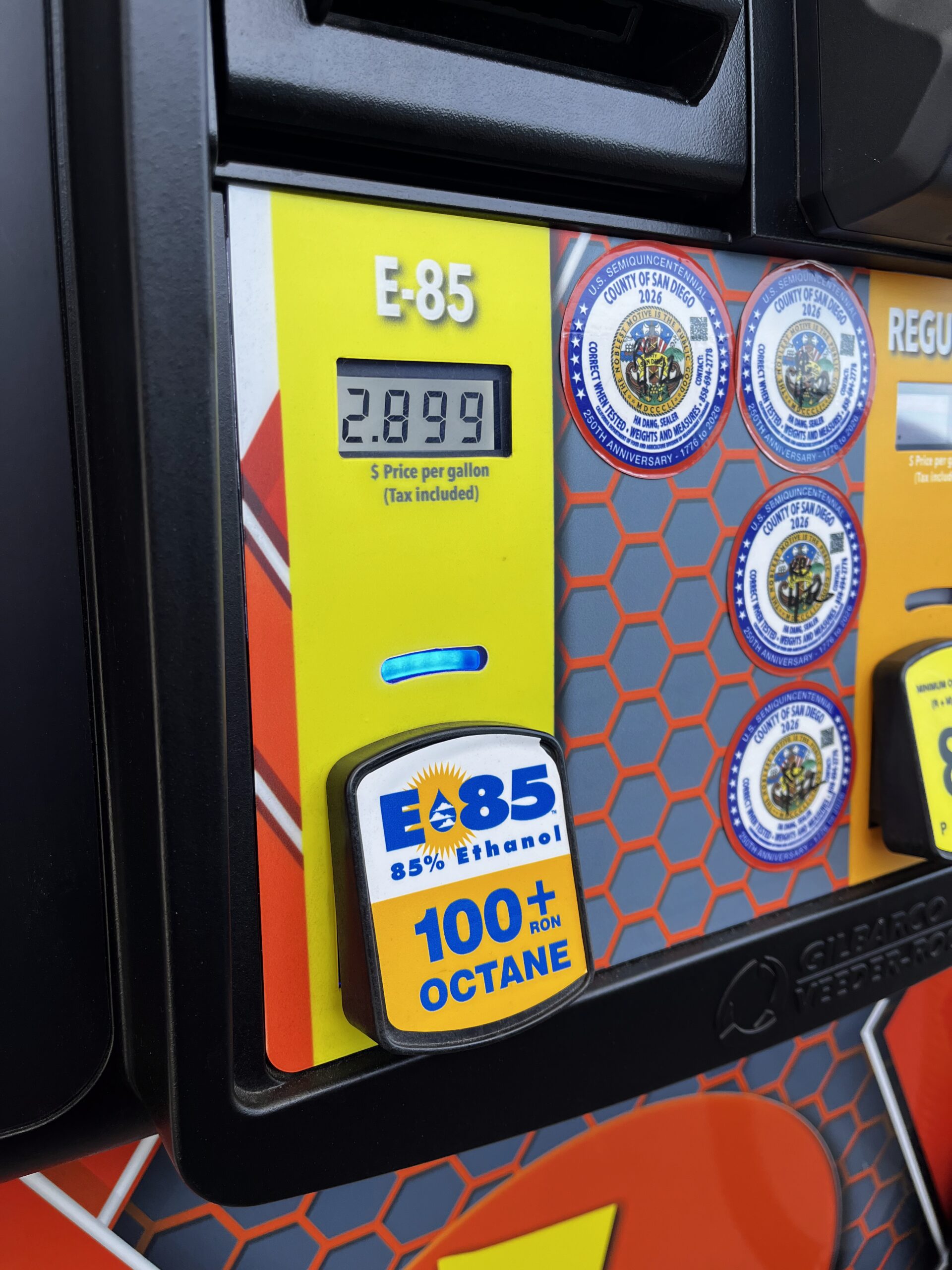
What is E85?
June 24th, 2026
Walk into any gas station that carries it and E85 stands out immediately — a yellow fuel handle, a lower price, and a label many drivers pass without a second thought.
But what exactly is E85?
The fuel itself
In California, E85 is a fuel blend made up of approximately 85 percent ethanol and 15 percent gasoline. Ethanol is a renewable fuel produced domestically, primarily from corn, making E85 a largely American-made fuel option.
The result is a fuel with a significantly higher octane rating than conventional gasoline. At Pearson Fuels stations, E85 is rated at 100 research octane number or higher, compared to 87 octane for regular gasoline and 91 octane for California premium.
Why drivers choose E85
One of E85’s most well-known advantages is its high octane rating.
Octane measures a fuel’s resistance to engine knock. Because E85 has a higher octane rating than conventional gasoline, it can support improved performance in vehicles designed or tuned to take advantage of it.
E85 also has natural cooling properties that can help reduce engine temperatures under demanding conditions. It’s one reason performance enthusiasts have used E85 for years.
Understanding the fuel economy trade-off
Because ethanol contains less energy per gallon than gasoline, vehicles running E85 typically experience lower fuel economy.
However, fuel economy is only part of the equation.
In California, E85 is often priced significantly lower than regular gasoline. The price gap is consistently $1.50-$2.00 cheaper than unleaded gasoline. For many drivers, the lower cost per gallon more than offsets the difference in fuel economy, resulting in real savings.
Who can use E85?
Today, approximately 1.1 million flex fuel vehicles are already on California roads.
Flex fuel vehicles are designed by manufacturers to operate on E85, gasoline, or any blend of the two. No modifications are required. Drivers can usually confirm whether their vehicle qualifies by checking the fuel door, fuel cap, owner’s manual, or manufacturer specifications.
AB 2046, the Access to Affordable Gas Act, passed the California Assembly 72–0 and is currently before the State Senate. If enacted, it would expand E85 access to additional compatible vehicles beyond current flex fuel vehicles.
California’s E85 network
California already has the largest E85 network in the country, with more than 600 stations offering the fuel statewide.
The infrastructure is already here, and expansion is continuing.
The bottom line
E85 is a domestically produced, high-octane fuel that offers eligible drivers performance benefits, lower fuel costs, and access to a growing fueling network across California.
The fuel has been here for decades. Today, more California drivers are learning about the benefits it offers.
Download the Pearson Fuels App to see real time pricing and stations near you.